What ParkSyde Life is
Most people meet us in pieces: a Facebook reel, a sign-up form, a word from a support coordinator. So here is the whole of it, in one place.
ParkSyde Life Pty Ltd is a small Australian care and community organisation based in Qld. We give practical, human help to people and families, especially people living with disability, children and the adults around them, and we say plainly what that help is and what it isn't. It comes in three kinds.
Care. Counselling and social work, alongside psychology and assessments and employment pathways, in person in Qld including Brisbane, or online. Both are shaped around what each person needs, and delivered only within what the practitioner's role validly covers. Counselling needs no referral. Some people pay with NDIS funds. We are not a registered NDIS provider, so we work with plans that are self-managed or plan-managed, not NDIA-managed, and we tell you that on the first call, not on the invoice. Support coordinators often point participants our way.
Learning. ParkSyde Learning supports families who home-educate, from Prep to Year 12. We are not a school and not a registering body: registration stays between the parent and their state's home education unit. What we add is structure, a calm way to plan learning, keep progress and print a record for the registrar. Alongside it sit practical AI courses for individuals, groups and workplaces. We are not an RTO and issue no accredited qualification.
Local work. Mowing, grounds and cleaning for homes, offices and community spaces in our local area in Qld, each priced at the published rate before any job starts, plus backing for local sport.
None of this is tied to one town. The model is built to adapt: the same care, learning and way of working can be set up in any community, in person or online.
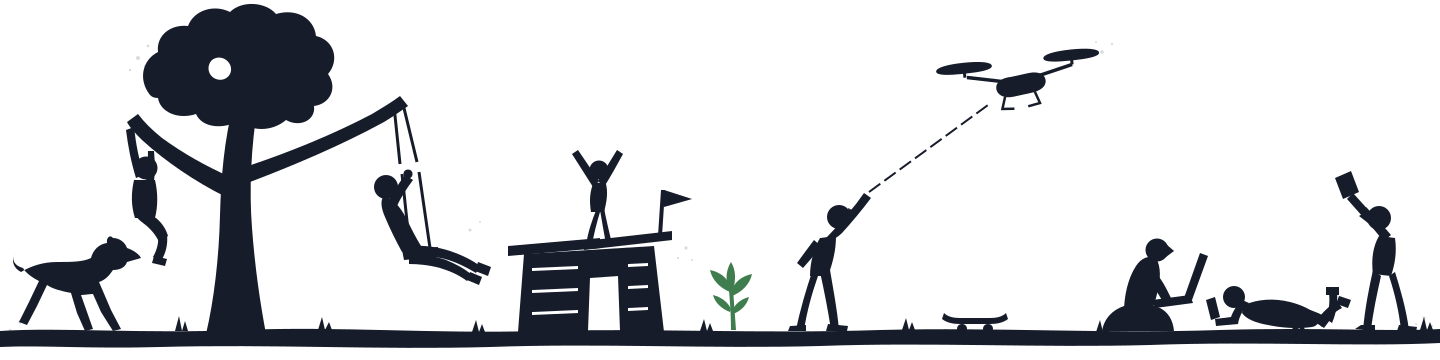
A park, not a service
A park doesn't take referrals. Nobody is a client of a park. You're not assessed at the gate, you don't have to prove need, and you leave when you want to.
It's just there, it's open, and the town is worse without it.
That's what we're building. Not a program people are placed into — something people reach for themselves.
Why the word matters
Most community services are built around eligibility. You have to be struggling enough, or funded enough, to get through the door. That does something to a person before they've even sat down.
A park doesn't do that. A park assumes you belong there already.
We still deliver real services — counselling, employment support, mowing, cleaning. But the posture underneath them is the park, not the intake form.
A park assumes you belong there already.
Instead of climbing trees
Kids used to build things in the park. Cubbies, ramps, whatever the older kids were doing.
That same instinct now goes into digital sandboxes. Young people build apps, games and tools — the making is identical, the material has changed. So we give them the sandbox, the tools, and someone nearby who knows what they're doing.
Our AI literacy work isn't a tech program. It's the same park, with different equipment.
Shoulder to shoulder
The Australian Men's Shed movement has a line worth borrowing, and we borrow it with credit: men don't talk face to face, they talk shoulder to shoulder. Not everyone, and not only men — but the truth in it is that some people open up beside a task and close up across a desk.
That is why one organisation does counselling and mows lawns and gives away games. They are not a diversified business; they are doors of different heights into the same place. A person who would never book a session will play a game their kid found. A bloke who would never ring a counsellor will talk while someone edges his mother's lawn. The work beside you is not a detour from the help — for a lot of people it is the help, and the conversation comes later or not at all, and both are fine.
It also means the ordinary work is not beneath the serious work. The person cutting the grass is doing community development with a mower.
What a park actually costs
Parks look effortless. That's the point of them — and it's also the lie.
The grass gets cut every week or it stops being a park. Someone empties the bins. Someone mends the swing before a kid gets hurt. The calm is manufactured, constantly, by people who mostly go unseen.
The idea is simple. The upkeep is not. It takes effort, and it takes awareness — of the community, of who has stopped showing up, of what's quietly slipping. It isn't one or the other. It's both, and it doesn't stop.
Anyone who tells you this runs itself has never mowed anything.
What we won't do
- We won't make people prove they're broken to get help.
- We won't use AI to replace a person who should be sitting with someone. We use AI to protect dignity, not automate care.
- We won't pretend the upkeep is free.
Built to outlast us
A park shouldn't depend on the person who planted it.
ParkSyde Life Pty Ltd has shared ownership, an advisory board and a governance charter — deliberately. The structure exists so the place outlasts any one person, founder included.
If it can only run with one particular person standing in the middle of it, it isn't a park.